Every B2B website says the same five things. Faster. Smarter. Built for teams. Trusted by leaders. Book a demo. A buyer comparing four vendors in your category is reading four versions of one page, and by the third they have stopped reading and started skimming for a reason to eliminate someone.
That is the actual job. Not persuasion, elimination. And you do not get eliminated on features, because at the shortlist stage the features are close enough that nobody can tell them apart. You get eliminated on whether the buyer believes the people behind the product understand their problem.
What a feature page cannot do
A feature page is a claim without a claimant. It asserts things in the passive voice of a company, and companies are not credible. People are. When a buyer reads “reduces onboarding time by 40%”, the unanswered question is not is that number real. It is who decided that number was worth putting on a page, and do they know what my onboarding actually looks like?
Video answers the second question in about eight seconds, because a person on camera leaks information a page cannot. Whether they are describing a problem they have lived or one they read in a positioning doc. Whether they are comfortable with the specifics or steering back to the script. Whether they sound like the person who will pick up the phone in month four.
Buyers are not evaluating your product in isolation. They are evaluating the cost of being wrong about you, and most of that cost is people, not software.
The asymmetry that makes it work
Here is the part most teams miss. Founder-led video is not better than a feature page at explaining the product. It is usually worse: less structured, less complete, harder to scan. It wins on a different axis entirely, and it wins there because almost nobody is competing on that axis.
Your competitors have a feature page. They have a comparison table. They have a case study PDF. What they mostly do not have is forty short videos of a named human being answering the specific objections their buyers raise, published where those buyers already spend forty minutes a day.
Who this actually works for
It is not universal, and pretending otherwise is how teams burn a quarter. Founder-led video works when three things are true at once:
- The deal is considered. Someone is going to hold at least two internal conversations before signing. If your product is bought in ninety seconds on a pricing page, trust-building content is overhead.
- The buyer is reachable in a feed. Heads of engineering, RevOps leads, security directors and founders are on LinkedIn. Plant managers and hospital procurement officers are largely not, and no amount of production quality fixes a channel mismatch.
- There is a real point of view. Not a differentiator in the marketing sense, but an actual opinion about how the work should be done, that some portion of your market will disagree with. Video with no position is a talking brochure and performs like one.
If any of the three is missing, the honest answer is that your money is better spent elsewhere. We turn away roughly one in five enquiries on the second point alone.
The founder does not have to be the founder
“Founder-led” is shorthand and it misleads people. What matters is that the face belongs to someone with standing to hold the opinion, meaning the person who built the thing, sells the thing, or has run the process the buyer is struggling with. A head of solutions engineering who has implemented the product ninety times has more standing on an implementation objection than the CEO does.
This matters practically, because the single most common reason a founder-led programme dies is that the founder runs out of time in week three. Spreading the face across two or three people is not a compromise. It is usually the version that survives.
What good looks like in practice
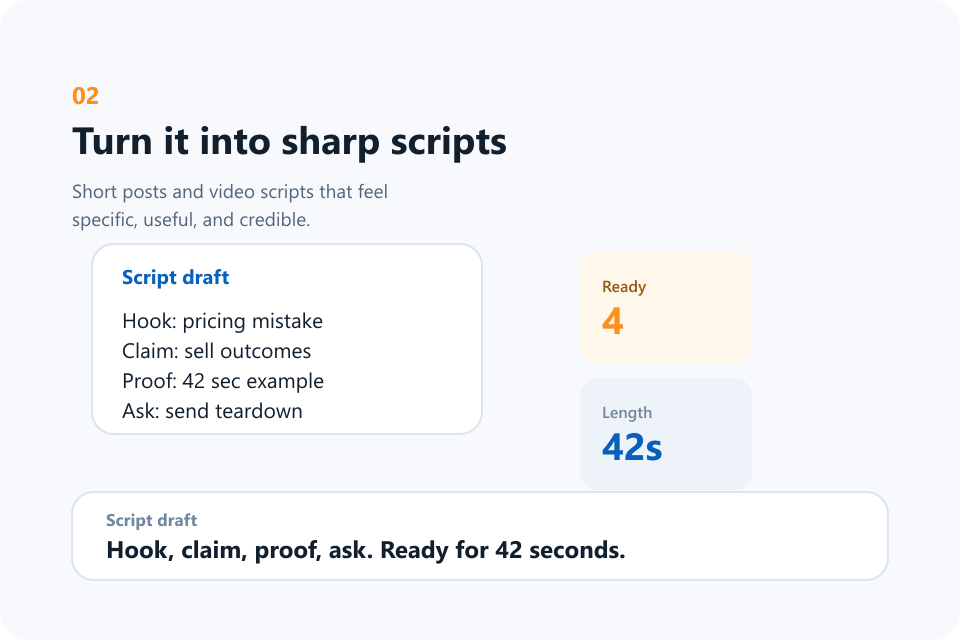
The format that works is narrower than most people expect. One idea per video. Sixty to ninety seconds. The idea stated in the first sentence rather than teased. No intro card, no logo sting, no “hey everyone”.
The reason is mechanical: a viewer decides in the first two seconds whether this is for them, and every second you spend on production furniture is a second spent not answering that question. We have watched retention curves on several hundred of these. The drop-off from a three-second branded intro is between eleven and nineteen percent, and it never recovers.
- State the claim. “Most onboarding projects fail in the data migration, not the training.”
- Give the specific. One real example, with a number or a name in it.
- Name the objection. The thing the viewer is already thinking. Say it out loud before they do.
- Stop. No call to action on most of them. The CTA belongs in the outreach that follows, not stapled to every idea.
Volume is the uncomfortable part
One good video does approximately nothing. The mechanism only starts working at the point where a buyer has seen you four or five times across a few weeks and has begun to form an impression before you ever contact them. That is the entire strategic argument for volume, and it is why “we’ll do a video a month when we have time” fails so reliably.
Getting to that volume is a production problem, not a strategy problem, which is a much easier problem to solve, and the one we wrote about in the cost breakdown of filming a month of video.
How to tell if it is working
Views are the worst metric available and the one everyone reports. A video that reaches two thousand of the wrong people and one that reaches two hundred of the right ones look opposite on a dashboard and are opposite in reality.
The signals that actually predict pipeline, roughly in order of how much we trust them:
- Reply sentiment on outreach. When people who have seen the videos reply differently from people who have not, the content is doing its job. This is measurable and it is the first thing to move.
- Profile views from target accounts. Slower, noisier, but it is the buyer doing research unprompted.
- Named references in calls. “I saw the one about migrations.” Rare, and worth more than any dashboard.
- Watch-through past thirty seconds. Not total views. The fraction that stayed.
Expect the first two to move in weeks four to seven. Anything faster is usually a spike from one video that happened to travel, which is pleasant and not repeatable.
The honest limitations
Founder-led video does not shorten sales cycles much. It changes what happens at the top of them, with more inbound-shaped conversations and fewer cold ones, but a six-month enterprise cycle stays a six-month enterprise cycle.
It also does not survive inconsistency. A programme that runs hard for six weeks and then stops does worse than one that never started, because the buyers who were forming an impression form a different one. If you cannot commit to a quarter, do something else.
And it is genuinely uncomfortable for most founders, for about three weeks. That is not a reason to avoid it, but it is a reason to build the process so that the uncomfortable part is one call rather than a standing obligation.
Leave a Reply